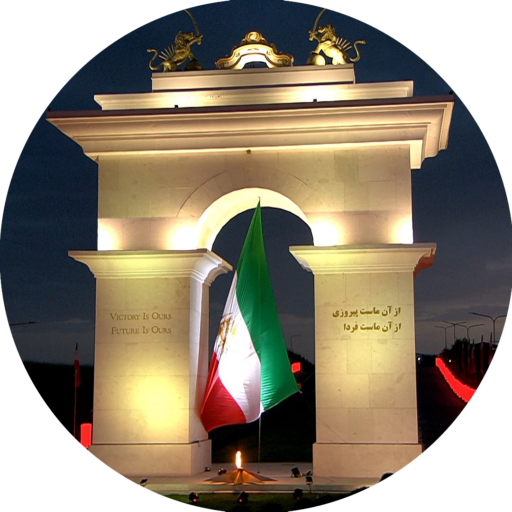

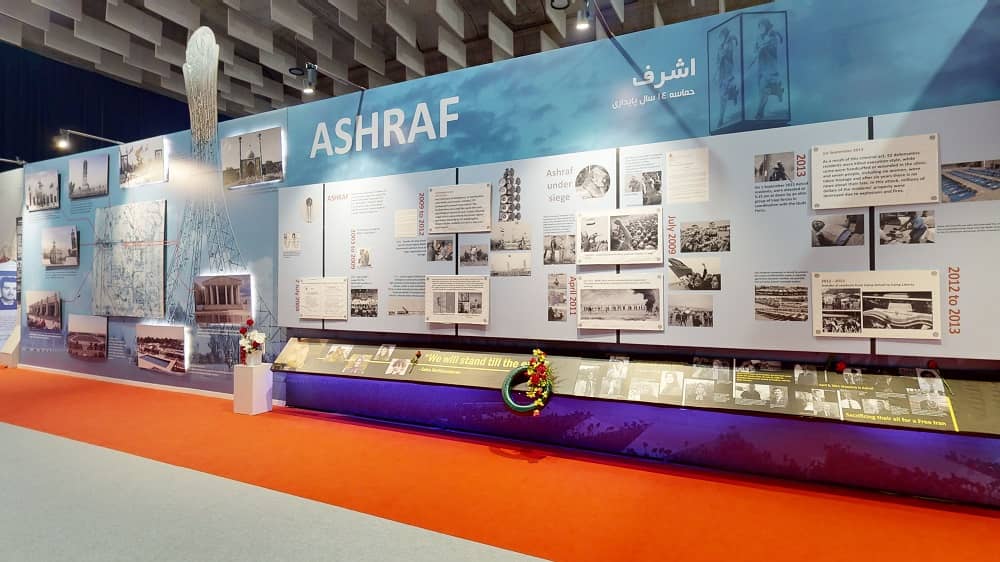
A section of the Iran Resistance Museum is dedicated to Ashraf 1, showcasing images and scenes from Ashraf City and the heroic events that took place there. Among these are photographs of the 52 martyrs who lost their lives in the September 1, 2013, massacre, as well as scenes from the historic battles of July 28-29, 1999, and April 8, 2011, which have been immortalized in the museum.
Establishment of Ashraf
Ashraf 1, located north of Khalis in Diyala Province, Iraq, approximately 80 kilometers from the Iranian border, served as the residence of thousands of members and supporters of the People’s Mojahedin Organization of Iran (PMOI/MEK) for over 25 years.
Camp Ashraf was established in 1986 after the leadership of the PMOI relocated from France to Iraq. Initially, it was barren land with only a few buildings and limited infrastructure. However, over 25 years, its residents transformed it into a modern city, the primary base of the PMOI in Iraq, complete with roads, buildings, educational facilities, assembly halls, and sports fields.
Naming of Ashraf
Also known as “Ashraf City,” the camp was named after Ashraf Rajavi, a well-known political prisoner under the Shah’s regime. Ashraf Rajavi was released from the Shah’s prisons in 1979 alongside the last group of political prisoners and was later was killed by the Iranian regime on February 8, 1982.
Interaction with the Local Community
Ashraf residents maintained excellent relations with the people of nearby cities and villages in Diyala Province. They built a water purification plant that provided drinking water to tens of thousands of local residents, and Ashraf’s medical clinics offered healthcare services to the surrounding population.
Ashraf and the 2003 Iraq War
In 2003, despite the PMOI’s declared neutrality in the U.S.-Iraq war, Camp Ashraf and PMOI camps were repeatedly bombed by coalition forces as part of a deal with the Iranian regime. However, after intense negotiations between the leadership of the National Liberation Army of Iran (NLA) and U.S. military officials, including General Raymond Odierno, commander of the U.S. 4th Infantry Division, an agreement was signed.
Following two days of negotiations, General Odierno told Agence France-Presse (AFP):
“This is not a surrender; it is an agreement for disarmament and the regrouping of fighters… It is clear to me that they are passionate about their struggle and believe in a democratic Iran. Perhaps I didn’t fully understand this when the negotiations began.”
After this agreement, PMOI members remained in Ashraf 1 while maintaining the structure of the National Liberation Army. In July 2004, the U.S. government granted Ashraf residents protection under the Fourth Geneva Convention.
Siege and Attacks on Ashraf
After U.S. forces withdrew from Iraq in 2008, the Iraqi government, acting on behalf of the Iranian regime, imposed a medical, logistical, and food blockade on Ashraf. The goal was to eliminate the PMOI, which had openly declared its objective of overthrowing the Iranian regime since 1981.
The first major attack on Ashraf occurred on July 28-29, 2009, when Iraqi forces launched a brutal assault on its residents. A second major attack followed on April 8, 2011. Eventually, under a tripartite agreement with the United Nations and the Iraqi government, Ashraf residents were transferred between February and August 2012 to Camp Liberty, near Baghdad International Airport. From there, after nearly four years, they were relocated to Albania.
While PMOI members were still in Camp Liberty, a third attack was carried out on the remaining residents of Ashraf, leading to the September 1, 2013, massacre. This attack resulted in the execution of 52 residents and the abduction of seven others, including six women. The assault was carried out by Iraqi special forces under the orders of then-Prime Minister Nouri al-Maliki. Despite international condemnation, no investigation was conducted, and the perpetrators were never held accountable.
Ashraf as a Global Symbol of Resistance
The resilience of Ashraf’s residents in the face of repeated attacks, along with their images resisting with bare hands against armed forces, turned Ashraf into a global issue. The political activities of PMOI members and supporters in Europe and the U.S., led by Maryam Rajavi, posed a challenge for many governments, including the United States, while also garnering support from tens of thousands of Iranians in exile, thousands of parliamentarians, and political figures worldwide.
As a result, the name “Ashraf” became a powerful symbol in the resistance culture of the PMOI and its supporters worldwide—an ideological, emotional, and strategic model that continues to inspire the Iranian opposition. Following the September 1, 2013, massacre, the PMOI adopted a new strategy based on this model, calling for the establishment of “A Thousand Ashrafs” inside Iran through resistance units dedicated to overthrowing the Iranian regime.