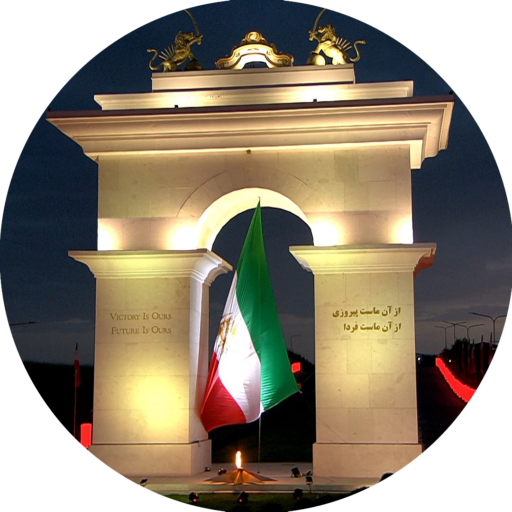

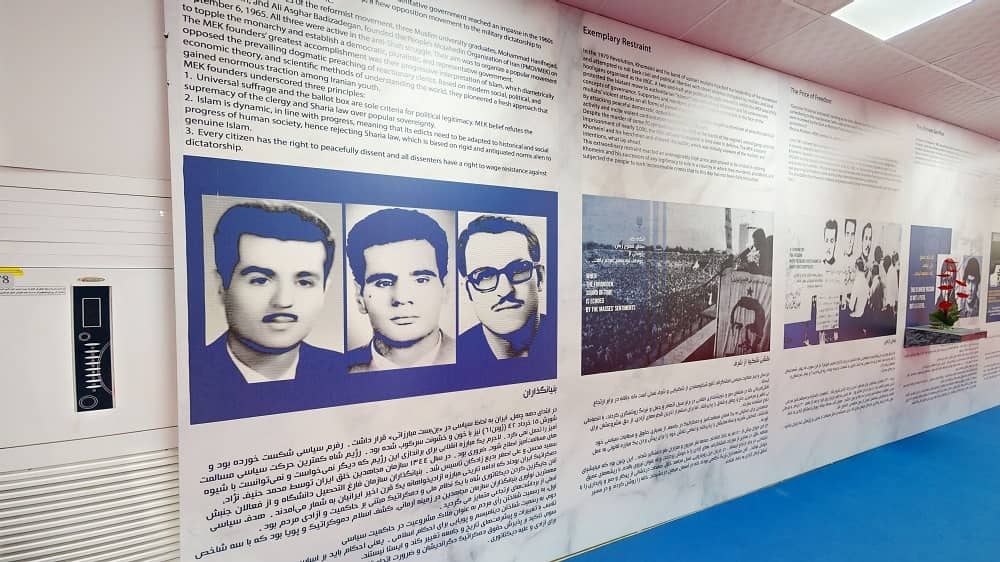
A section of the Museum of the Iranian Resistance in Ashraf 3 is dedicated to the founding of the People’s Mojahedin Organization of Iran (PMOI/MEK). Through all its ups and downs, it serves as a reminder of the seed sown on the very first day by the organization’s founders, which has now grown into a mighty tree with vast branches spanning the entire world.
On September 6, 1965, the People’s Mojahedin Organization of Iran was founded by its great founders Mohammad Hanifnejad, Saeed Mohsen, and Asghar Badizadegan. At a time when traditional and passive methods of struggle in Iran had reached a dead end and the dictatorship of the Shah had stifled every breath, all claimants had either surrendered to compromise with the Shah’s regime, become indifferent in pursuit of their own lives, or succumbed to the dominance of SAVAK. However, the great founders of the Mojahedin, Mohammad Hanifnejad and his comrades, Saeed Mohsen and Asghar Badizadegan, established the PMOI/MEK.
They analyzed the experiences of past national and freedom-seeking struggles of the Iranian people and, for the first time in Iran’s history, founded a organization based on true Islam—rejecting all reactionary interpretations of Islam. Their approach relied on dedicated, professional revolutionaries ready to make the ultimate sacrifice.
Due to his extensive activities, Hanifnejad was arrested by the Shah’s SAVAK two days before the fraudulent referendum in February 1963. While in prison, he wrote political analyses and developed new ideological perspectives, sending them to his friends outside. After his release, and amidst the bloody suppression of the June 5, 1963 uprising, Hanifnejad and his friend Saeed Mohsen studied Iranian movements and struggles—particularly the methods of Iran’s political parties and the reasons for their failures. They concluded that the primary cause of past failures was the absence of a competent leadership—one equipped with the knowledge of struggle, a revolutionary theory, and readiness for both action and sacrifice.
In mid-September 1965, Mohammad Hanifnejad, Saeed Mohsen, and Asghar Badizadegan laid the foundation of the PMOI/MEK. With a novel and creative understanding of monotheism and Islam—free from reactionary and exploitative interpretations—Mohammad Hanifnejad studied the Qur’an and Nahj al-Balagha as the most authentic sources of ideology and a guide for action, explaining their concepts in depth.
With the same dedication, he also studied various philosophical, social, and revolutionary schools of thought. For Hanifnejad, solving the problems of humanity—especially contemporary humans and the suffering, exploited people of Iran—was crucial. He believed that any idea guiding humanity toward progress and any doctrine freeing the enslaved must be embraced, utilizing the achievements of others.
Hanifnejad believed that a person’s duty is not just to understand society but to change it toward progress. His sense of responsibility toward the oppressed and exploited drove him to action. He firmly held that if an intellectual or a fighter is not with the people and among them—if they spend years studying and thinking in isolation—they will never bring about the slightest change in society.
At that time, the dominant perception was that being revolutionary meant being anti-God and anti-religion, while believing in Islam meant defending exploitation and the ruling classes. But Mohammad Hanifnejad presented a new formula, declaring:
“The primary dividing line in socio-economic issues is not between those who believe in God and those who do not, but between the exploited and the exploiters.”
Hanifnejad played a pivotal role in shaping the PMOI/MEK’s ideological discussions. His brilliance and historical significance stem from the fact that a small group, without any resources, took such a monumental historic step.
Over the years, despite countless conspiracies and attacks from both the Shah’s and the clerical regime, the PMOI/MEK has endured. With the sacrifice of 120,000 martyrs for Iran’s freedom, it has survived the most severe political, military, ideological, and organizational storms and emerged even more powerful and determined—a beacon of hope for the future of the Iranian people.
Loyalty to the ideal of freedom and selfless sacrifice for the liberation of the Iranian people is the key to the PMOI/MEK’s endurance since its founding on September 6, 1965. The organization stands today as the backbone of a steadfast resistance and coalition for Iran’s liberation.