
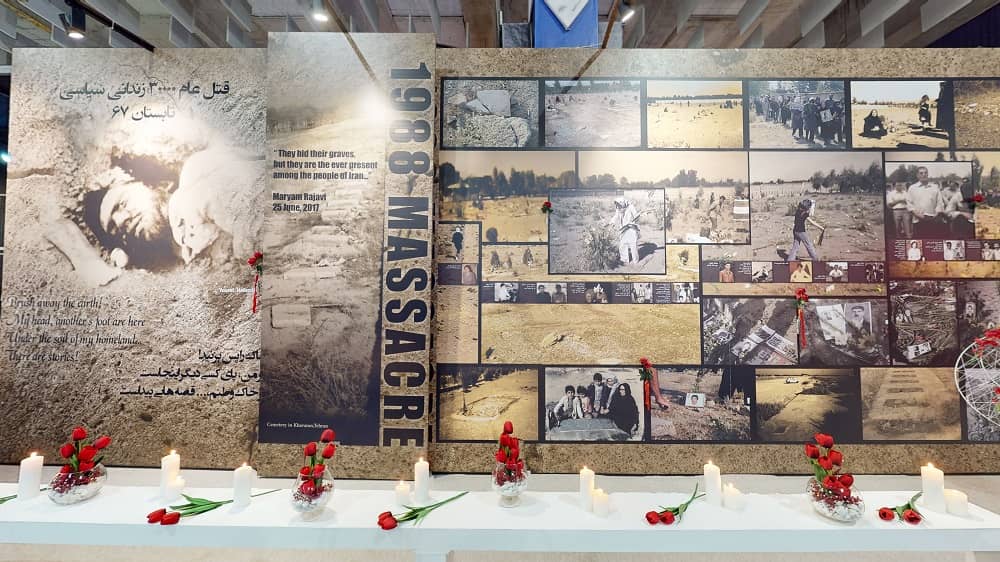
In the Museum of Iranian Resistance, a dedicated exhibit honors the Khavaran Cemetery, serving as a poignant reminder of the atrocities committed by the Islamic Republic of Iran in the 1980s. This exhibit sheds light on the mass executions and unmarked graves of political prisoners, preserving the memory of the victims and emphasizing the resilience of their families in their pursuit of justice.
The Khavaran Cemetery, located in southeastern Tehran, is recognized as one of the most significant documents of the crimes committed by the Islamic Republic of Iran during the 1980s. This site serves as the burial ground for thousands of political prisoners who were executed in the summer of 1988 and buried in unmarked mass graves.
Location and Features of Khavaran Cemetery
Khavaran Cemetery is located at kilometer 15 of the Imam Reza Highway in southeastern Tehran. Covering an area of approximately 30 by 60 meters, it is a barren plot of land without headstones, surrounded by iron bars. Adjacent to the cemetery lies a burial ground for members of the Bahá’í community. Families of the executed are not permitted to place headstones or plant trees, and potential gravesites are marked with fragments of bricks or colored pebbles.
In the early 1980s, particularly after June 1981, the Tehran municipality allocated a piece of land on the Khurasan Road, 15 kilometers from Tehran and next to cemeteries for religious minorities, as a burial site for political prisoners executed by the regime. This location, later known as Khavaran, was initially used to bury members of leftist groups and the People’s Mojahedin Organization of Iran (PMOI/MEK).
As the number of executions increased in subsequent years, particularly during the summer of 1988, the number of burials in Khavaran rose significantly. Families of the victims, initially unaware of their loved ones’ burial locations, gradually discovered the cemetery through persistent efforts, identifying it as a mass grave site for those executed.
The 1988 Massacre
In the summer of 1988, following a fatwa by Ruhollah Khomeini, over 30,000 political prisoners—mostly members and supporters of the PMOI—were executed within a short period. These executions were carried out without fair trials and in secret, and the victims’ bodies were buried in mass graves, including in Khavaran.
Efforts to Destroy Evidence of the Crimes
The Islamic Republic of Iran has repeatedly attempted to destroy Khavaran Cemetery and similar sites across other cities under various pretexts. Multiple reports have documented attempts by the Iranian regime to demolish the graves of the victims of the 1988 massacre. In May 2021, reports of plans by the regime to dig new Bahá’í graves in Khavaran Cemetery sparked widespread outrage.
International Reactions
International human rights organizations, including Amnesty International, have condemned the destruction of Khavaran Cemetery and called for these actions to cease. They emphasize that such sites are evidence of crimes against humanity and must be preserved, as their destruction represents an attempt to erase evidence of these atrocities.
The Justice-Seeking Movement and Khavaran Mothers
Families of the executed, especially their mothers, have formed groups such as the “Khavaran Mothers” to demand justice and honor the memory of the victims. Despite ongoing pressure and threats, they regularly gather at the cemetery, calling for accountability and the identification of those responsible for these crimes.
Legacy of Khavaran Cemetery
Khavaran Cemetery stands as a symbol of repression and the atrocities committed by the Islamic Republic in the 1980s. Preserving this site and documenting the associated crimes are crucial to preventing the recurrence of such tragedies and achieving justice.
In subsequent years, with the efforts of families and human rights activists, more information about Khavaran was revealed, and the site has come to symbolize the repression and human rights violations in Iran. Today, Khavaran remains a testament to the resilience and justice-seeking efforts of the families of those executed in the 1980s, with ongoing endeavors to preserve and document the site.