
Gohardasht Prison is one of Iran’s most notorious prisons, infamous for the mass executions of political prisoners in the 1980s, particularly during the 1988 massacre. Covering approximately 200,000 square meters, it is located in the northeast of Gohardasht city, bordered by the city on the south and west and by the Alborz mountain range on the north and east.
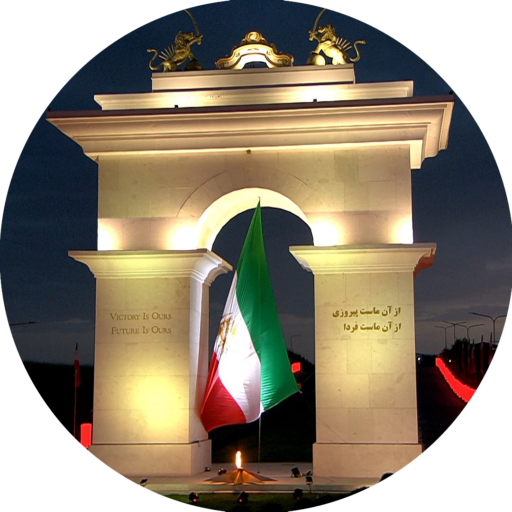
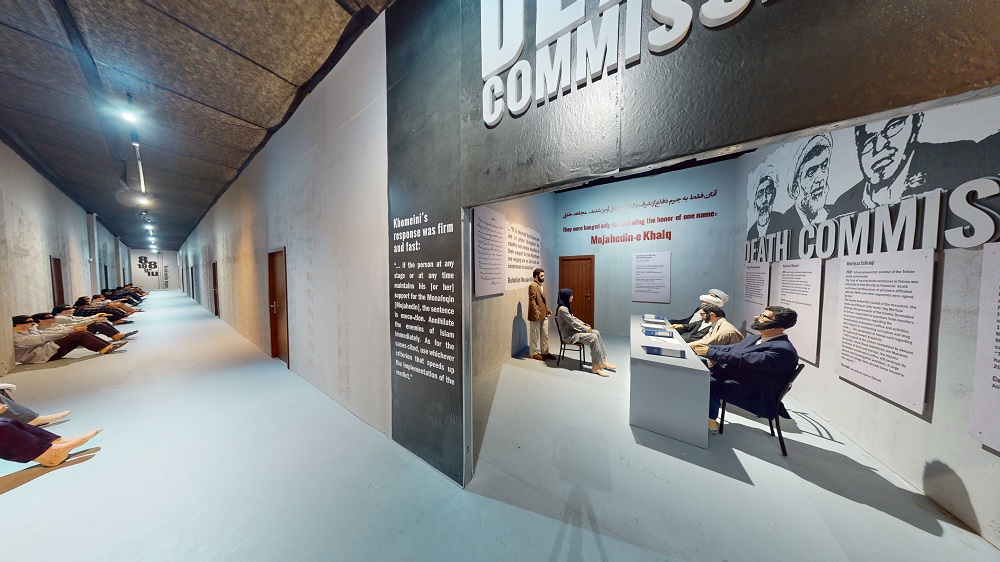
At Ashraf 3, a museum has been established that features a Replica of parts of Gohardasht Prison, including the Death Corridor and execution sites. These reconstructions, created with detailed models and simulations, allow visitors to understand the harsh and inhumane conditions of the prison.
One of the most notable replicas was presented during the trial of Hamid Nouri, a deputy prosecutor of Gohardasht Prison during the 1988 massacre, in Sweden. During the trial, lawyer Kenneth Lewis brought a model of Gohardasht Prison to the courtroom to provide a tangible representation of the prison conditions and the treatment of inmates. This model was meticulously reconstructed based on the testimonies of survivors of the 1988 massacre, and a large image of it is now displayed in the Ashraf 3 Museum.
A replica of Gohardasht #prison
In the Death Corridor, blindfolded prisoners were seated one to two meters apart, waiting to be taken one by one to the Death Commission Room for their fate to be decided.#stopexecutionsiniranhttps://t.co/BVFteMNqGj pic.twitter.com/PdjT3nHEg3— freeiranmuseum (@freeiranmuseum) January 30, 2025
Gohardasht Prison was primarily designed as a facility with solitary cells, consisting of 24 wards across eight three-story blocks. Each block is separated by a courtyard used for prisoners’ outdoor time. Each ward contains 40 solitary confinement cells, with the last two cells in each ward serving as bathrooms. Three of the 24 wards were turned into general wards, where two cells were merged into one and given wooden doors. These three general wards are located on the third floor of the three southern blocks. As a result, 21 wards remain exclusively for solitary confinement.
Beyond these wards, the prison also includes:
- An eastern block entirely dedicated to the kitchen and storage facilities.
- A western block serving as the prison’s medical unit.
- An adjacent block housing the meeting hall and administrative offices.
The meeting hall is located on the middle floor of this block, while the first floor contains the offices of the prison warden, deputy prosecutor, archives, and other administrative sections. Part of the third floor houses the control room for the meeting hall, where conversations of prisoners are continuously monitored and recorded.
At the northern end of the prison’s main corridor, there is a large amphitheater that the regime refers to as a Hosseiniyeh (a religious gathering hall). However, this location was actually used for hanging members of the MEK (Mujahedin-e Khalq) during the 1988 massacre. Thousands of MEK members and other dissidents were executed in Gohardasht Prison during the massacre. In addition to prisoners already serving sentences there, exiled MEK prisoners from cities such as Mashhad and Kermanshah were also executed at this site.
In the 1988 massacre of political prisoners, Gohardasht Prison's "Death Hall" was where defiant prisoners were hanged after brutal torture. Explore this scene at the Museum of Iranian Resistance. #Iranhttps://t.co/BVFteMNYvR pic.twitter.com/0cj9NSIbOS
— freeiranmuseum (@freeiranmuseum) January 16, 2025