

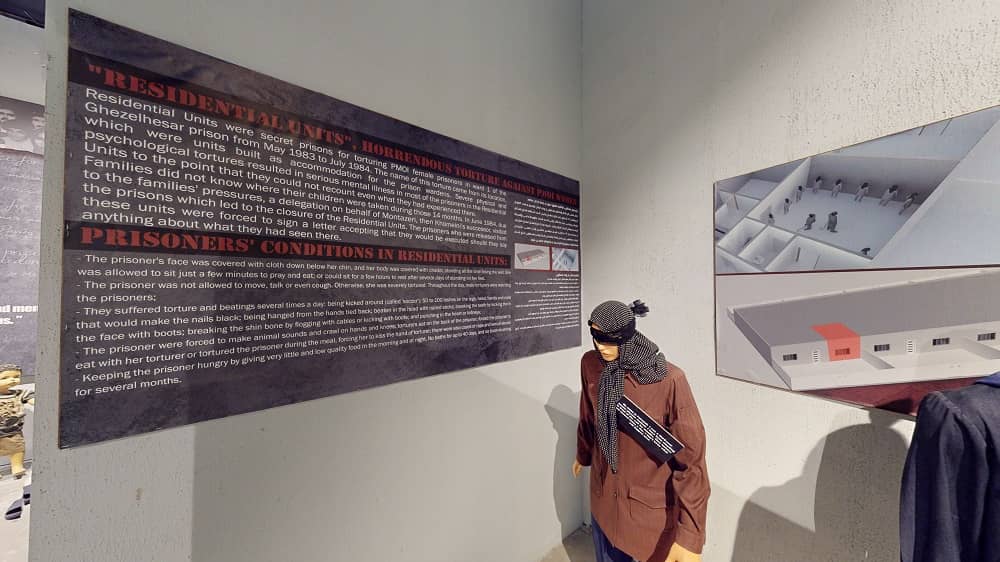
At the Museum of Iranian Resistance, a replica of Iran’s prisons has been created to showcase the brutal torture methods used by the regime against political prisoners, particularly women. One of the most ruthless torture sites was the Residential Unit in Ghezel Hesar Prison, designed to break the spirit of resistant and Mujahedin women. This article examines the torture methods used in the Residential Unit and presents the firsthand testimony of Homa Jaberi, one of the survivors of this hell.
Residential Unit: A Hidden Torture Chamber
The Residential Unit was a secret torture chamber established by the Iranian regime after failing to break female prisoners through traditional methods such as solitary confinement and physical torture. Prisoners were secretly transferred there, and their families had no knowledge of their whereabouts, leading many to search for their loved ones across different cities.
Only Asadollah Lajevardi, the notorious executioner of Evin Prison, and his torturers had access to this facility. Inside, prisoners were subjected to brutal physical and psychological torture, often kept in complete isolation.
Testimony of Homa Jaberi: A Survivor’s Account
Homa Jaberi, a survivor of the savage tortures in the Residential Unit, recounts her ordeal:
“I am Homa Jaberi, and I spent five and a half years in the prisons of the mullahs’ regime. I have documented my experiences in a book, and here, I will summarize what I went through.
On June 20, 1981, when I was 18, I was arrested during a 500,000-strong Mujahedin demonstration in Tehran and transferred to Evin Prison. I spent two years in Evin before being moved to Gohardasht Prison.
The Iranian regime, inherently misogynistic and particularly hostile toward Mujahedin women, resorted to creating a secret torture chamber called the Residential Unit in Ghezel Hesar Prison after failing to break women through conventional torture and solitary confinement.
Families had no information about their children’s whereabouts and searched for them in various cities. Only Lajevardi and his torturers had access to this chamber.
I was transferred to the Residential Unit along with some of my friends. The torture began immediately upon transfer. The torturers beat us with fists, kicks, and cables inside the vehicle. When we arrived, they threw us out of the car. The beatings were so severe that we couldn’t stand and kept collapsing. They then dragged us into a room, blindfolded us with thick cloths to completely cover our faces, and the torture began.
They said, ‘Tonight, we will kill you.’
They kicked us like soccer balls. Suddenly, a heavy blow struck my heart, and I screamed in pain before collapsing. But screaming was considered a crime, and anyone who screamed was tortured even more severely.
This continued until midnight. My face was swollen, and my hands were paralyzed from the cable blows. Then Lajevardi came and said:
‘This is the end of the road for you. This is your hell. No one hears you. Scream all you want, but we will finish you here.’
For three days, we stood facing the wall without rest, tortured to the point of delirium. On the third day, I lost consciousness.”
Life in the Residential Unit: An Endless Nightmare
In the Residential Unit, the torturers remained in the same room 24/7. Prisoners were not allowed to rest and were forced to stand still, blindfolded, facing the wall.
Homa Jaberi recalls:
“I spent 40 days under these conditions. Some before me endured this for six months to a year. No sound was allowed—coughing or sneezing was a crime and resulted in further torture.
Every order was enforced with cables, punches, and kicks. If we received a cable lash, it meant we might get an hour of sleep a few days later.
Several times a day, the torturers played loud religious chants and elegies before attacking us with punches and kicks. Even during prayer or meals, they would kick us hard in the ribs and slam us against the wall.”
Transfer to Evin Prison: Continuing the Suffering
After 40 days, Homa was transferred to Evin Prison. There, she saw many of her fellow prisoners again—after more than a year of separation, they were completely broken, both mentally and physically.
“Those who survived the Residential Unit had endured such extreme psychological torture that they couldn’t even describe what had happened to them. Some said they were forced to behave like animals and make animal noises.”
Many of the women from the Residential Unit were executed during the 1988 massacre, including Farangis Mohammad Rahimi, Shokar Mohammadzadeh, Ashraf Fadaei, and Tahmineh Sotoudeh.
Conclusion
The Residential Unit was one of the most barbaric torture sites of the Iranian regime, designed to crush the spirit of resistant Mujahedin women. The testimonies of survivors like Homa Jaberi stand as evidence of the regime’s crimes against humanity. However, what remains is the resilience and resistance of these women, who, even in the darkest moments, held on to the light of hope.