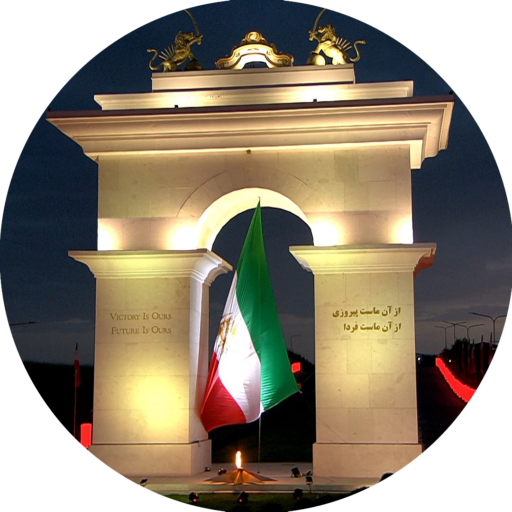


At the Museum of Iranian Resistance, a replica of prisons and various methods of torture has been reconstructed to give visitors a realistic understanding of the atrocities committed in the prisons of the Iranian regime. These models depict the brutal methods used against political prisoners, particularly freedom-seeking men and women. One of the most inhumane methods, known as “Cage Torture,” was practiced in Ghezel Hesar Prison. This article explains this form of torture and presents the testimony of Hengameh Haj Hassan, an eyewitness who endured this harrowing ordeal. Cage Torture: A System Designed to Destroy the Body and Soul The “cage” was a wooden enclosure measuring approximately 160 cm × 60 cm, with a height of 70 cm. These cages were installed in multiple rooms within Ghezel Hesar Prison, where prisoners were forced to remain inside for hours, or even months, without the slightest movement. Sitting motionless, being forbidden to speak, and even having to bow their heads to avoid the relentless blows from torturers were just some of the sufferings these miniature prisons inflicted. Prisoners inside the cages were punished even for coughing or sneezing. Any involuntary movement or any noise caused by their bodies touching the wooden boards resulted in severe whipping. Many prisoners suffered lifelong physical injuries due to these brutal tortures. Hengameh Haj Hassan’s Testimony: Seven Months of Cage Torture Hengameh Haj Hassan, a survivor and eyewitness to this barbaric torture, recounts her experience: “I am Hengameh Haj Hassan. I was a nurse and worked at Sina Hospital in Tehran. In 1981, I was arrested for supporting the People’s Mojahedin Organization of Iran (PMOI/MEK). Many of my colleagues were arrested before me, and many were executed, including Dr. Fahimeh Mirahmadi, who was pregnant at the time. Our crime was helping wounded protesters and those injured by the Revolutionary Guards.” “I spent a year in Evin Prison before being transferred to Ghezel Hesar. The tortures continued there—sleep deprivation, cold temperatures, lack of access to showers, overcrowded cells, and ultimately, *the ‘residential unit,’ the cage, and the coffin torture.’” “I personally endured seven months inside a cage. We had no idea what was awaiting us. One day, the guards stormed our ward and violently forced us into these cages. Blindfolded and wearing a chador, we were crammed into the tight enclosures where we had to sit motionless. The slightest movement or body contact with the wooden walls resulted in whipping and further torture.” “Because I was tall, my head extended above the height of the cage. The torturers constantly struck my head with batons and whips, forcing me to lower it. This led to severe spinal injuries, and despite five surgeries, I still suffer from physical complications. My left eye was also damaged and became misaligned due to these beatings.” The Transformation of Prisoners Due to Cage Torture After seven months, our faces changed so drastically that even our cellmates no longer recognized us. The torture was constant, and any noise from the cage resulted in severe punishment. For instance, if a spoon accidentally hit a plate while eating, the guards would accuse us of “Morse coding” to communicate with other cells and would brutally beat us. Davoud Rahmani, the head of Ghezel Hesar Prison, proudly declared: “This is Judgment Day, the end of the road. We will kill all of you, and no one will ever hear your cries.” Our families searched for us for months, but there was no trace of us. Visitations were completely cut off, and even prisoners had no way of knowing whether it was day or night. Struggling to Survive in Absolute Darkness To survive, we had to find ways to maintain our spirits. Every day, we recalled poetry, songs, and memories to keep our minds active. I even mentally devised a workout routine for myself, though I was unable to move at all. At night, to counteract the loud religious chants played to keep us awake, I would imagine scenes of nature in my mind, trying to transport myself away from the horrors of the cage to find moments of peace. Torture That Only Strengthened Our Resolve The guards believed they could break us through these tortures, but the result was the opposite. We became even more certain of our path and committed to continuing our struggle. A few of us survived, bearing witness to these horrors, but most prisoners who endured the cage were executed during the 1988 massacre. Inside prison, we saw ourselves as representatives of our organization and felt a duty to uphold our ideals and leadership. The more they tortured us, the more we believed in the righteousness of our cause. After being released from prison, we reunited with our organization and have continued on this path ever since. Conclusion Cage Torture was one of the most barbaric and inhumane methods used to crush political prisoners under the Iranian clerical regime. The testimony of eyewitnesses like Hengameh Haj Hassan serves as undeniable evidence of the regime’s crimes, showing that they spared no effort in trying to destroy the body and spirit of their opponents. Yet, what remained was not defeat, but resilience and unwavering defiance. Even in the depths of darkness, the prisoners kept the light of hope alive. Today, the Museum of Iranian Resistance preserves these truths, demonstrating that the spirit of freedom and justice can never be chained.
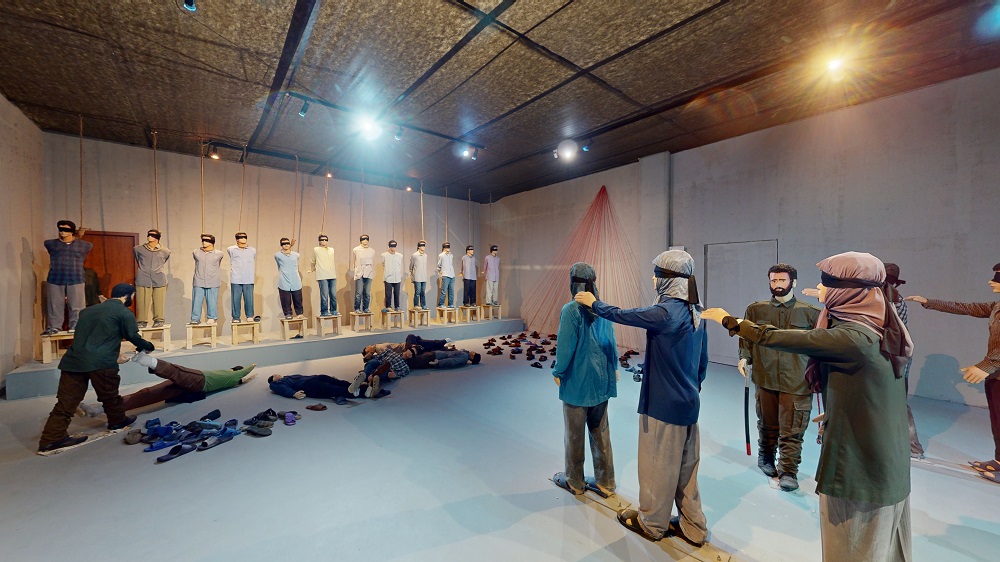
The Replica of Death Hall in Gohardasht Prison
At the Iran Resistance Museum in Ashraf 3, a replica of Gohardasht Prison and its infamous Death Hall has been reconstructed. The Death Hall was where prisoners were executed in groups. In the summer of 1988, following a fatwa issued by Ruhollah Khomeini, then Supreme Leader of the regime, a wave of mass executions swept through Iran’s prisons, leading to the secret execution of over 30,000 political prisoners, the vast majority of whom were members and supporters of the People’s Mojahedin Organization of Iran (PMOI/MEK). In Gohardasht Prison, one of the most notorious prisons in Iran, executions took place in a hall that later became known as the “Death Hall.” This hall was located in the northern section of the prison’s main corridor. However, during the 1988 massacre, it was transformed into an execution site. Eyewitness Account of the Massacre Asghar Mehdizadeh, one of the few survivors of the 1988 massacre, was among those who entered the Death Hall and miraculously lived to tell the story. He was imprisoned in various prisons from 1980 to 1994 and was present in Gohardasht during the massacre. His chilling account of what he witnessed in the Death Corridor and Death Hall has been documented in horrifying detail. Mehdizadeh recounts: “In front of the Hosseiniyeh (which was also an amphitheater), about 300 to 400 prisoners were sitting in the corridor. They were all blindfolded, waiting. Some were praying. I asked one of them why they had brought them there. He replied: ‘For several nights, they have been bringing us here, but it hasn’t been our turn yet, so they send us back.’” He continues: “I sat in the corridor for about an hour. Then, a guard suddenly opened the Hosseiniyeh or Death Hall door and loudly ordered the prisoners to stand up. Twelve prisoners immediately rose and began chanting “Hail to the Mojahedin!” They were taken inside the Death Hall in three separate groups. More prisoners from different wards were then brought into the corridor. Some of them broke their watches and glasses so they wouldn’t fall into the hands of the guards. Others tore up their wills and money to prevent them from being confiscated.” “When the fourth group was called, a guard took me into the Death Hall and positioned me 30 meters from the stage. Through the gap in my blindfold, I could see the bodies of those who had been executed, piled up on the stage.” Mehdizadeh adds: “Inside the Death Hall, 12 nooses hung from the ceiling above the stage. The bodies of executed prisoners were stacked on top of each other while the guards searched through them, looking for any remaining belongings. The corpses were then carried to the prison yard, where vehicles were waiting to transport the bodies away.” He continues: “Each time a group of prisoners entered the hall, a chair was placed under each noose. Some prisoners, fully aware of their fate, walked toward death with courage. A guard standing next to me laughed as he watched the scene unfold.” A Symbol of Crimes Against Humanity The Death Hall of Gohardasht Prison remains a symbol of the atrocities committed by the clerical regime and its blatant human rights violations. It stands as a silent witness to the crimes inflicted upon defenseless prisoners. Today, efforts to document these atrocities and seek justice for the victims continue. At the Ashraf 3 Museum, the replica of Death Hall has been reconstructed to eternally honor the memory of those who gave their lives for freedom in Iran.
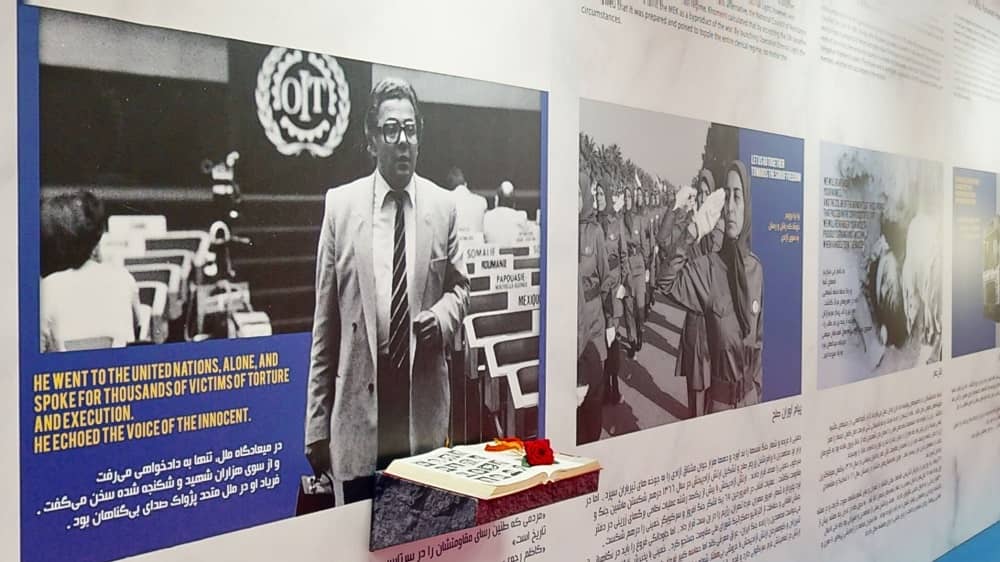
Wall of Honor – Dr. Kazem Rajavi
In the Museum of Iranian Resistance in Ashraf 3, images of freedom fighters and influential figures in Iran’s contemporary history are displayed. Among them is the portrait of Dr. Kazem Rajavi, the great martyr of human rights, who dedicated all his resources and capabilities to supporting the Iranian Resistance and ultimately sacrificed his life for this cause. Dr. Kazem Rajavi was born on February 18, 1934, in Mashhad, Iran. He was the elder brother of Massoud Rajavi, the leader of the Iranian Resistance. Kazem Rajavi completed his primary and secondary education in Mashhad and, after obtaining his diploma, taught for two years. In 1954, he was admitted to university to study law and later pursued his higher education in Switzerland. Dr. Rajavi obtained a professorship in law in Switzerland and became a university professor and a faculty member at the Graduate Institute of International and Development Studies in Geneva. He played a pivotal role in saving his brother, Massoud Rajavi, from execution during the Pahlavi regime. After Massoud Rajavi’s arrest in October 1971, Dr. Kazem Rajavi, who was then a professor in Geneva, launched an extensive international campaign to prevent his brother’s execution. Using his academic status and global connections, he successfully brought the attention of human rights organizations and international bodies to his brother’s case. These efforts included global exposure of the case and outreach to human rights institutions, which ultimately led to the commutation of Massoud Rajavi’s death sentence to life imprisonment. His Role in the Resistance and Human Rights Advocacy After the 1979 Revolution, Dr. Kazem Rajavi was appointed as Iran’s first ambassador to the United Nations in Geneva. However, he soon resigned in protest and joined the ranks of the Iranian Resistance. He became the representative of the National Council of Resistance of Iran (NCRI) in Switzerland and played a significant role in exposing the human rights violations committed by the Islamic Republic at international forums. Dr. Rajavi’s extensive human rights advocacy and efforts to expose the atrocities of the clerical regime provoked the fury and hostility of Iran’s ruling authorities. Finally, this distinguished human rights defender and NCRI representative in Switzerland was assassinated near Geneva on April 24, 1990, by a 13-member hit squad sent from Tehran. Following the assassination, investigations revealed that the operation was orchestrated and executed by agents of the Iranian Ministry of Intelligence. In the years that followed, legal efforts were made to pursue justice for this crime. Eventually, the Swiss Federal Court ordered the Swiss Attorney General to investigate Dr. Kazem Rajavi’s murder as a crime against humanity and genocide. His Legacy and Commemoration The memory of Dr. Kazem Rajavi as the great martyr of human rights remains alive in the hearts of the Iranian people and the international community. Every year, on the anniversary of his assassination, a commemorative ceremony is held in front of the European headquarters of the United Nations in Geneva to honor his tireless efforts and sacrifices in defending human rights.
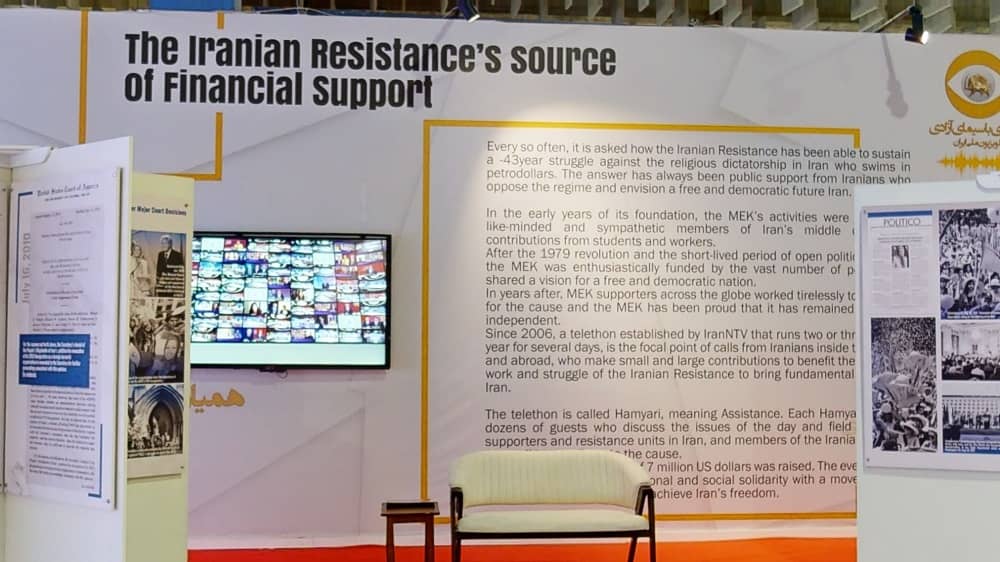
The Simaye Azadi telethon
In the Iranian Resistance Museum, located in Ashraf 3, a section called the ” Simaye Azadi telethon” is dedicated to showcasing the role of public contributions in sustaining and maintaining the independence of Simaye Azadi, the television network of the Iranian Resistance. This section highlights the commitment and solidarity of Iranians in supporting a media outlet that, without reliance on any government, serves as the voice of resistance and the struggle for freedom. Simaye Azadi, as the only independent 24-hour Persian-language television channel, has always emphasized financial independence since its establishment in the 1980s. All of its operational costs are covered through public donations and support programs. These contributions—whether small individual donations or significant financial commitments—demonstrate the public’s trust in and dedication to the Iranian Resistance. The Simaye Azadi fundraising programs, held periodically, provide an opportunity for widespread participation in funding the television network and expressing support for the resistance. During these programs, Iranians from inside and outside the country call in to donate, showing their backing for the Iranian Resistance and the People’s Mojahedin Organization of Iran (PMOI/MEK). For example, many individuals from inside Iran make small donations, which, despite their modest amounts, carry immense symbolic and moral significance. On the other hand, many from both inside and outside Iran contribute substantial sums, often explaining that their financial support stems from their deep trust in the resistance and the PMOI/MEK, which has paid a heavy price in the struggle for Iran’s freedom. These public contributions reflect not only the deep trust and faith Iranians have in the Iranian Resistance and the PMOI/MEK but also the financial independence of the movement. To learn more about the role of public support for Simaye Azadi, you can visit the online Iranian Resistance Museum. This virtual museum is accessible online and features various sections dedicated to the history of the Iranian people’s struggle.
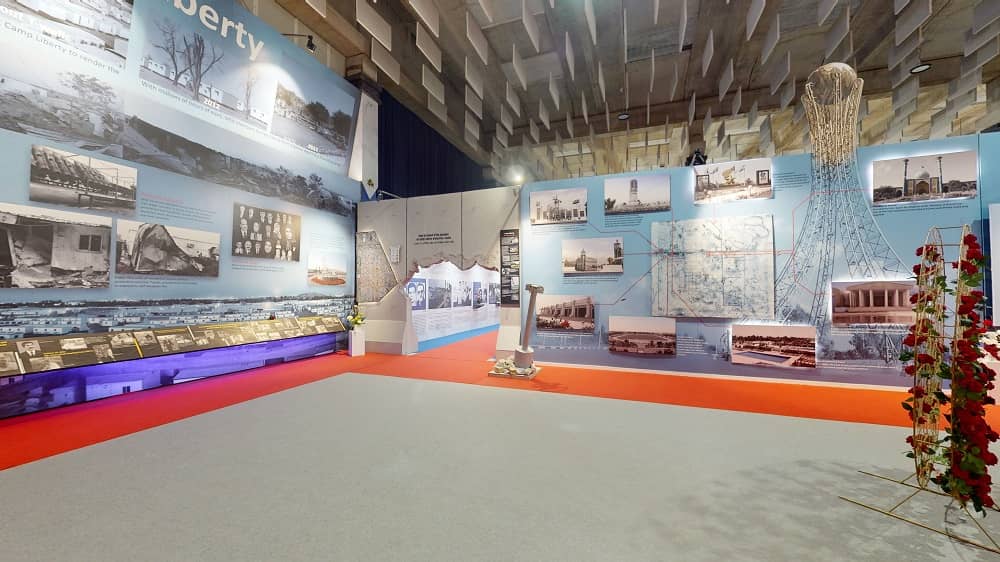
Fourteen Years of Resistance in Ashraf and Liberty
In the Museum of Iranian Resistance, a section is dedicated to the glorious 14-year resistance of the members of the People’s Mojahedin Organization of Iran (PMOI/MEK) in Camp Ashraf and Camp Liberty. The photos and images of this resistance, which stand as a golden chapter in the 120-year struggle of the Iranian people, serve as a lesson for all revolutions and a guide for every freedom fighter who is willing to sacrifice everything in the path of liberation. From 2003 to 2017, the PMOI/MEK members in Camp Ashraf and Camp Liberty in Iraq demonstrated extraordinary perseverance and resilience in the face of numerous threats and attacks. This 14-year period became a symbol of the organization’s unwavering commitment to its ideals. Camp Ashraf and the 2003 Iraq War Before the 2003 U.S.-led war in Iraq, the PMOI (MEK) publicly declared neutrality and played no part in the conflict. In the early part of the invasion, as a result of the quid pro quo between Washington and Tehran, PMOI (MEK) bases were repeatedly bombed by Coalition forces, inflicting dozens of casualties and enormous structural damage. In April 2003, US forces signed a cease-fire agreement of “mutual understanding and coordination” with the PMOI (MEK). Finally, in May 2003, as a result of negotiations between the PMOI (MEK) and US forces led by General Ray Odierno, the PMOI (MEK) agreed to a “voluntary consolidation” and disarming of its forces in exchange for US protection of Camp Ashraf and its residents. Protected Persons Status under the 4th Geneva Convention After an extensive 16-month investigation of every member of the PMOI (MEK) in Camp Ashraf by seven different US government agencies that began after the US agreement, PMOI (MEK) members were found not to have violated any US law [New York Times, July 27, 2004]. In addition, the US Government declared them to have been “non-combatants” during the 2003 war. In 2004 the US-led Multi-National Force – Iraq (MNF-I) formally recognized all the residents of Camp Ashraf as “Protected Persons” under the Fourth Geneva Convention [Coalition Statement, July 2004], and U.S. forces took up their protection. The MNF-I reiterated its obligations towards Ashraf residents under the 4th Geneva Convention on numerous occasions. This can be seen in a February 16, 2006 letter by the then-Deputy Commanding General, and it is also specified in the October 7, 2005, letter by Maj. Gen. William Brandenburg says: “The residents of Camp Ashraf have the right to protection from danger, violence, coercion, and intimidation, and to special protection for the dignity and rights of women.” In January 2009, despite strong opposition by the residents and several legal opinions by distinguished jurists, the camp’s security was transferred to Iraq without necessary credible guarantees. The US stated that the Government of Iraq had given a written guarantee respecting the residents’ rights. Massacres at Camp Ashraf In July 2009 and April 2011, the Iraqi Army, under the direct order of Prime Minister Nuri al-Maliki, launched deadly attacks on Camp Ashraf. The first attack left 11 Ashraf residents dead and nearly 500 wounded. The 2011 attack – described by then U.S. Senator John Kerry, Chairman of the Senate Foreign Relations Committee, as a “massacre” – left 36 dead and hundreds wounded. The attacks drew widespread condemnation from the international community. In 2009, the camp came under a barbaric siege where delivery of food, fuel, and medicine was hampered, and visits by family members, human rights organizations, residents’ lawyers, and independent journalists were disallowed. For nearly two years, the Camp residents were constantly subject to psychological torture by agents of the Iranian regime using some 320 powerful loudspeakers threatening the residents with death and using abusive words all through day and night. During the tenure of Nouri al-Maliki, the Iran-backed Iraqi Prime Minister, PMOI/MEK members were attacked 27 times in Ashraf and Liberty, resulting in: 117 martyrs,1,380 injured, 7 individuals taken hostage, including 6 female members, whose fate remains unknown. Additionally, due to the medical blockade imposed on Ashraf and Liberty since 2008, 27 members lost their lives due to lack of medical care. Fourteen Years of Glorious Resistance The leadership of the Resistance played a key role in guiding the struggle of PMOI/MEK members in Ashraf. In his message regarding the disarmament process, the leader of the Iranian Resistance declared: “I preferred those who carried the weapons over the weapons themselves.” With a deep understanding of the region’s geopolitical landscape and an accurate prediction of Iran’s growing influence in neighboring countries, he called on PMOI/MEK members to remain patient and steadfast in their principles. This strategy proved correct, as Iranian regime influence expanded across Iraq, Syria, Lebanon, and Yemen in the years that followed. Despite harsh conditions and repeated attacks, PMOI/MEK members continued their resistance throughout this period. Images and reports of their unyielding perseverance drew global attention and international support. The UN Secretary-General, members of various parliaments, and international political figures voiced their support for the Ashraf residents. Eventually, through international efforts and to ensure the safety of PMOI/MEK members, they were relocated to Albania between 2016 and 2017. This marked the end of 14 years of resistance in Ashraf and Liberty and the beginning of a new chapter in the PMOI/MEK’s struggle. Upon their relocation, the organization announced its new strategy: “A Thousand Ashrafs” and the creation of “Resistance Units” aimed at toppling the Iranian regime. The 14-year resistance of PMOI/MEK members in Ashraf and Liberty stands as a symbol of their commitment and perseverance in the face of relentless pressure and threats. It ensured the continuation of the organization’s struggle and became an inspiration for young people inside Iran. As the leader of the Iranian Resistance declared at the beginning of this campaign: “If Ashraf stands, the world will stand against the Iranian regime.”
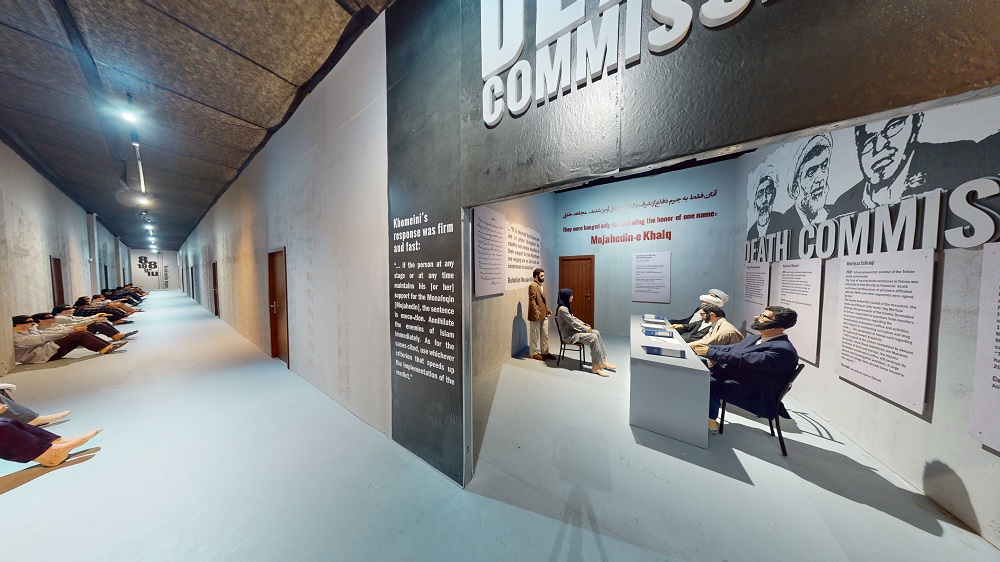
Replica of Gohardasht Prison
Gohardasht Prison is one of the most notorious prisons in Iran. It gained infamy in the 1980s due to the mass executions of political prisoners, particularly during the 1988 massacre. The prison, covering approximately 200,000 square meters, is located in the northeast of Gohardasht city. It is bordered by Gohardasht to the south and west and extends to the foothills of the Alborz Mountains to the north and east. A museum has been established in Ashraf 3, where replicas of sections of Gohardasht Prison, including the ‘Death Corridor’ and the ‘Execution Site,’ have been reconstructed. These reconstructions, created with highly detailed models and simulations, allow visitors to experience the harsh and inhumane conditions that prevailed in this prison. One of the notable models was presented during the trial of Hamid Nouri, a deputy prosecutor at Gohardasht Prison during the 1988 massacre, in Sweden. In this trial, lawyer Kenneth Lewis brought a model of Gohardasht Prison to the court to provide a tangible depiction of prison conditions and the treatment of prisoners. This model was meticulously reconstructed based on the testimonies and accounts of survivors of the 1988 massacre. Structure of Gohardasht Prison The prison is primarily composed of solitary confinement cells and consists of 24 wards across 8 three-story blocks. Between each block, there is a yard designated for prisoners’ outdoor time. Each ward contains 40 solitary cells, with the last two cells serving as bathrooms. Three of the 24 wards are general wards where every two solitary cells have been combined into one, with wooden doors added. These three wards are located on the third floor of the three southern blocks. This means that the remaining 21 wards in the prison consist entirely of solitary confinement cells. Beyond the wards, the prison has three additional blocks: The eastern block is entirely used for the kitchen and supply storage. The western block houses the prison infirmary. The block adjacent to the infirmary contains the visitation hall and administrative offices. The visitation hall is located on the middle floor of this block, while the prison warden’s office, prosecutor’s office, archives, and other administrative rooms are on the first floor. Part of the third floor contains the visitation monitoring room, where conversations between prisoners and their visitors were constantly monitored and recorded. Execution Hall and the 1988 Massacre In the northern section of the prison’s main corridor, there is a large amphitheater that the clerical regime refers to as a Hosseiniyah (religious hall). However, in reality, this hall was used as the execution site for Mojahedin prisoners during the 1988 massacre. During the 1988 executions, thousands of PMOI and resistance prisoners were hanged in Gohardasht Prison. In addition to prisoners who were already serving sentences there, exiled PMOI prisoners from the cities of Mashhad and Kermanshah were also executed in this prison.
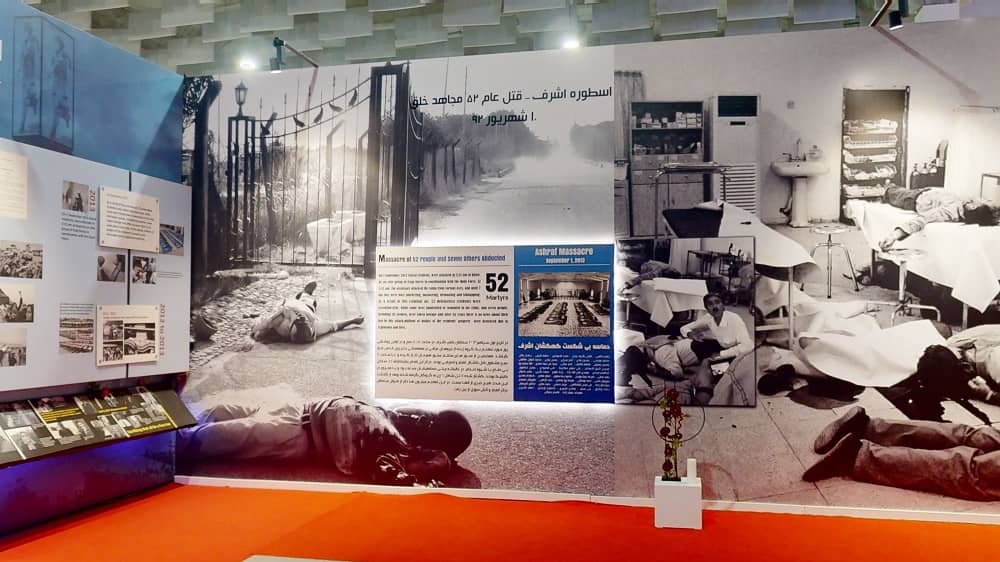
Ashraf Massacre Exhibit in the Museum of Iranian Resistance
The Museum of Iranian Resistance features an exhibit dedicated to the Ashraf Massacre. On September 1, 2013, Camp Ashraf, the residence of members of the People’s Mojahedin Organization of Iran (PMOI/MEK) in Diyala Province, Iraq, was subjected to a pre-planned attack that resulted in the massacre of 52 residents and the abduction of seven others, whose fate remains unknown to this day, raising ongoing concerns about their whereabouts. The attack was carried out by Iraqi Special Forces, known as the Golden Division, in coordination with the Quds Force of the Iranian Revolutionary Guards (IRGC). Evidence indicates that this operation was meticulously planned with full coordination between the Iraqi government and the Iranian regime. The assailants stormed Camp Ashraf simultaneously from 10 different locations at 5:15 AM, using firearms, explosives, and grenades to target defenseless residents. Many victims were executed with their hands tied, highlighting the premeditated intent for mass murder. Destruction and Financial Losses In addition to the massacre of 52 PMOI members, the attack on September 1, 2013, also inflicted extensive financial losses. Reports indicate that the assailants detonated over 200 explosions, causing millions of dollars in damage to Ashraf’s facilities and infrastructure. The destruction included buildings, equipment, and vital infrastructure, demonstrating a deliberate effort to completely obliterate the camp. Siege and Pre-Attack Coordination The attack occurred while Camp Ashraf was under siege by Iraqi forces, with the Iraqi government having cut off water and electricity for weeks to exert additional pressure on the residents. Reports confirm that Qasem Soleimani, the commander of the IRGC Quds Force at the time, traveled to Iraq just days before the attack and met with then-Iraqi Prime Minister Nouri al-Maliki to finalize the operational details. Iraqi Government’s Denial and Conflicting Accounts Following the massacre, Iraqi authorities initially denied any incident had occurred. However, as photos and documented reports emerged, they began offering contradictory narratives. Some Iraqi security sources later confirmed that Iraqi forces had opened fire on Ashraf residents. This attack is a clear example of the close collaboration between the Iraqi government and the Iranian regime in suppressing Iranian opposition members. The assault on Ashraf was explicitly designed to physically eliminate members of the PMOI, serving the Iranian regime’s interests. The massacre has been condemned as a blatant violation of human rights and international law. For more information on this atrocity and other crimes committed by the Iranian regime, you can visit the Online Museum of Iranian Resistance, which provides a virtual experience detailing the history of the Iranian people’s struggle for freedom.
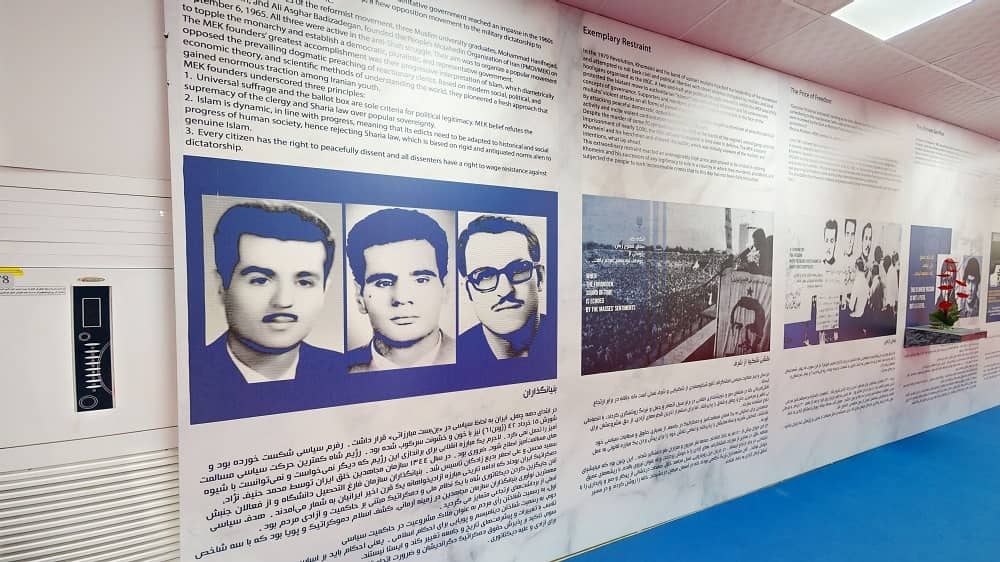
The Founders of the People’s Mojahedin Organization of Iran
A section of the Iranian Resistance Museum in Ashraf 3 is dedicated to the founding of the People’s Mojahedin Organization of Iran (PMOI/MEK), serving as a reminder of the seed planted on the very first day by its founders—now grown into a mighty tree with branches reaching across the world. On September 6, 1965, the PMOI/MEK was founded by its great founders Mohammad Hanifnejad, Saeed Mohsen, and Asghar Badizadegan. At a time when traditional and passive methods of struggle had reached a dead end in Iran, and the Shah’s dictatorship had suffocated all voices of dissent, many opposition groups had either surrendered to compromise with the regime, remained indifferent, or fallen under the grip of SAVAK (the Shah’s secret police). However, the great founders of the PMOI/MEK—Mohammad Hanifnejad, Saeed Mohsen, and Asghar Badizadegan—established the organization as a new revolutionary force. They analyzed the past national and pro-freedom struggles of the Iranian people and, for the first time in Iran’s history, founded a revolutionary organization based on Islam—rejecting all reactionary interpretations of Islam. They established a revolutionary strategy that relied on professional and dedicated revolutionaries willing to sacrifice everything for their cause. Most importantly, Mohammad Hanifnejad and his comrades broke a historic dogma by removing the veil of reactionary interpretations from the ideals of Islam and monotheism. The Early Years of the PMOI/MEK The idea of establishing an organization with professional revolutionaries had been in development for years. Due to his widespread political activities, Mohammad Hanifnejad was arrested by SAVAK two days before the Shah’s sham referendum in February 1963. While in prison, he wrote his political analyses and ideological interpretations and sent them to his comrades outside. After his release and in the aftermath of the brutal suppression of the June 5, 1963 uprising, Hanifnejad, alongside Saeed Mohsen, studied the history of revolutionary movements in Iran, focusing on why Iranian political parties had failed. They concluded that the primary reason for past failures was the absence of a competent leadership—one that was scientifically equipped for the struggle, armed with a revolutionary theory, and ready for both ideological and practical revolutionary action. Following the suppression of the June 5, 1963 uprising, when reformist approaches had reached a dead end, the PMOI/MEK founders realized that the era of reformist efforts was over. This revolutionary discovery led to the formation of what would later be known as the People’s Mojahedin Organization of Iran. In mid-September 1965, Mohammad Hanifnejad, Saeed Mohsen, and Asghar Badizadegan laid the foundation of the PMOI/MEK. With a fresh and innovative understanding of Islam and monotheism, free from reactionary and exploitative interpretations, Hanifnejad studied and explained the concepts of the Quran and Nahj al-Balagha (a collection of Imam Ali’s sermons) as the organization’s ideological foundation and guide to action. At the same time, he studied various philosophical, social, and revolutionary schools of thought, focusing on solving the problems of humanity—particularly the suffering and exploitation of the Iranian people. Hanifnejad believed that any ideology that guides human development and liberates the oppressed is progressive and should be embraced. The Legacy of the PMOI/MEK’s Founders Mohammad Hanifnejad’slife exemplifies the path of great revolutionaries who refuse to submit to tyranny and oppression. Despite all the torture and pressure, he remained steadfast in his pursuit of a just and humane society. Despite all the conspiracies and attacks by both the Shah’s and the mullahs’ regimes to destroy it, the PMOI/MEK has survived and thrived—paying the price of 120,000 martyrs for Iran’s freedom. It has endured brutal political, military, ideological, and organizational storms but has emerged stronger than ever, serving as a beacon of hope for Iran’s future. Loyalty to the ideal of freedom and selfless sacrifice for the liberation of the Iranian people is the secret to the PMOI/MEK’s endurance—an organization founded on September 6, 1965, that has become the backbone of a lasting resistance and coalition for Iran’s liberation.
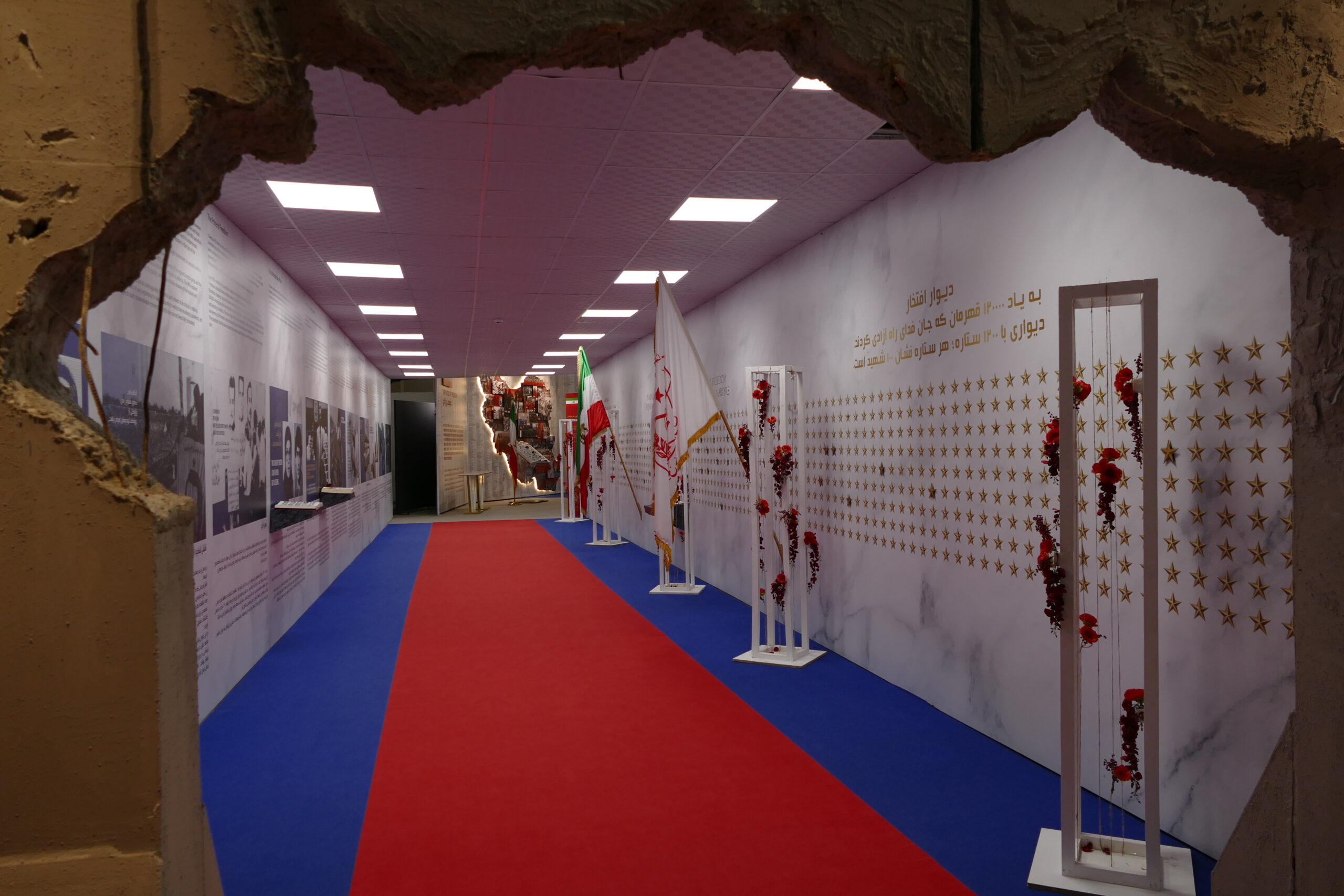
Wall of Honor in the Museum of Iranian Resistance
The Wall of Honor in the Museum of Iranian Resistance commemorates 120,000 martyrs who gave their lives for freedom after the Iranian people’s anti-monarchy uprising. Each star on the wall symbolizes 100 martyrs. These individuals came from various political groups, though the majority were members and supporters of the People’s Mojahedin Organization of Iran (PMOI/MEK). The wall also features inspiring images depicting the struggles of the PMOI from its inception to the present day. At the forefront of this display is a plaque marking the founding of the PMOI. This foundation was a continuation of Iran’s Constitutional Revolution and the nationalization of the oil industry movement, led by Dr. Mohammad Mossadeq. The seeds planted by the organization’s founders have since grown into a mighty tree with branches extending across the world. On September 6, 1965, the People’s Mojahedin Organization of Iran was founded by Mohammad Hanifnejad, Saeed Mohsen, and Ali Asghar Badizadegan. At a time when traditional and passive forms of struggle had reached a dead end and the dictatorship of the Shah was suffocating the people, these great founders, as Ayatollah Taleghani put it, opened the path of resistance through their organization. For two and a half years, the PMOI carried out extensive political activities, including mass rallies and speeches by the leader of the Iranian Resistance in various cities. These activities represent a proud and unforgettable chapter in the organization’s history, demonstrating its deep roots in Iranian society. During this period, the PMOI’s awareness campaigns exposed the true face of Khomeini’s regime and proved that the organization utilized every last ounce of freedom before being forced into armed resistance against Khomeini. However, on June 20, 1981, the Revolutionary Guards and repressive forces of the regime opened fire on a peaceful demonstration of 500,000 people in Tehran and launched a wave of executions. From that moment on, resistance until the last breath became the only path forward. The PMOI’s Ashura took place on February 8, 1982, when Commander Mousa Khiabani and Ashraf Rajavi, the symbol of revolutionary women in the PMOI, were martyred. This event became a symbol of ultimate sacrifice in the struggle for freedom against the ruling reactionary regime. The Wall of Honor in the Museum of Iranian Resistance also immortalizes the name of Dr. Kazem Rajavi, a martyr for human rights, who was assassinated by the Iranian regime’s terrorists in Geneva in 1990. Dr. Rajavi played an unparalleled role in the history of the Iranian resistance, as he was instrumental in saving the leader of the Iranian Resistance from execution in the Shah’s prisons. His unyielding spirit continues to serve as a shield for justice, an advocate for the martyrs of the PMOI, and a relentless exposer of the regime’s crimes. In the summer of 1988, the clerical regime committed one of the most horrific crimes in Iran’s modern history. Over the course of a few months, around 30,000 political prisoners, mostly members and supporters of the PMOI, were executed en masse in prisons across the country, particularly in Gohardasht Prison in Karaj. According to eyewitnesses, each of these prisoners chose martyrdom with pride, refusing to bow before the enemy. The history of the PMOI is filled with glorious chapters of resistance, sacrifice, heroism, and struggle. It is a history written in the blood of 120,000 martyrs and countless prisoners who endured torture yet remained steadfast in their commitment to overthrowing the regime. It is the story of men and women who gave up everything, marching into battle with iron will and unshakable determination to keep the flame of freedom alive. The Museum of Iranian Resistance seeks to symbolically display this history so that by looking at it, the bright horizon of victory becomes even more visible and inevitable. .
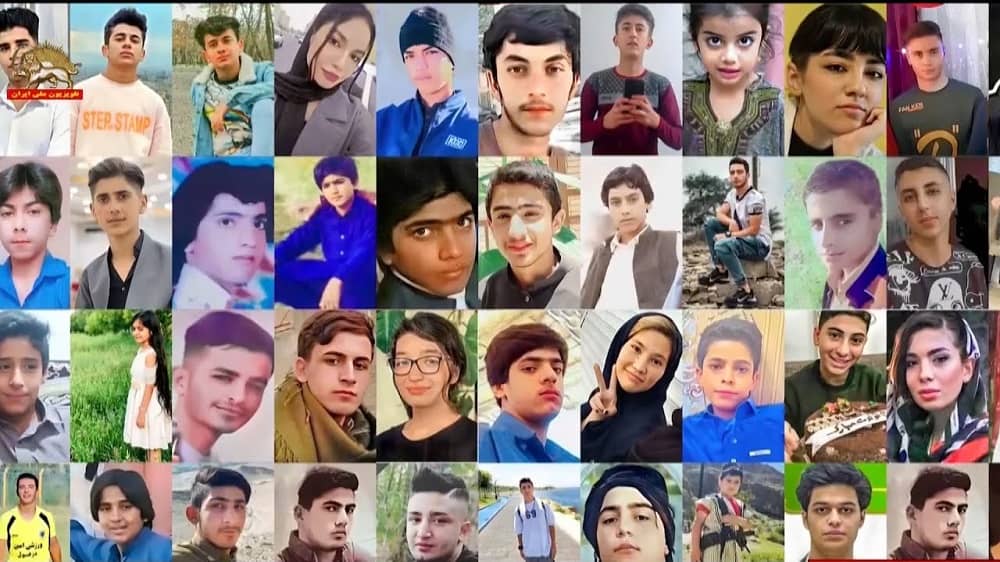
Martyrs of the Uprisings
Since September 2022, Iran has witnessed unprecedented nationwide uprisings triggered by the death of Mahsa Amini while in the custody of the morality police. These protests quickly spread to more than 280 cities and were met with severe repression by security forces. During these protests, many young people and teenagers lost their lives. According to reports, by March 2023, the number of martyrs had exceeded 750. In the Museum of Iranian Resistance, a section is dedicated to the martyrs of the uprising. Among the most prominent martyrs was Mahsa Amini, a 22-year-old woman from Saqqez, whose death ignited these uprisings. Additionally, 16-year-old Nika Shakarami and 16-year-old Sarina Esmailzadeh were killed in Tehran and Karaj, becoming symbols of youth resistance. These uprisings were particularly intense in major cities such as Tehran, Isfahan, Shiraz, Mashhad, Tabriz, and Sanandaj. In Tehran, neighborhoods like Naziabad, Yaftabad, and Golebandak witnessed large-scale gatherings. Widespread protests also took place in Sanandaj, Mahabad, and Bukan. According to reports, by February 2023, more than 30,000 people had been arrested. Prisons and Detainees: Many protesters are being held in various prisons across the country, with reports of torture and mistreatment. Prisons such as Evin in Tehran, Adelabad in Shiraz, Vakilabad in Mashhad, Lakan in Rasht, Qarchak in Varamin, and Ghezel Hesar in Karaj are among the locations where detainees are being held. For instance, in Qarchak Prison, on the anniversary of the 2022 uprising, female prisoners staged a protest, which was met with violent suppression, leaving at least 20 people injured. The international community has strongly condemned the suppression of protests in Iran. Amnesty International, in a statement, declared that the deadly crackdown on protests in Iran requires an urgent international response and called on world leaders to pressure Iranian authorities to stop the killing and injuring of more protesters.